
What Mothers Really Need
What Mothers Really Need
By Dr. Hasti Raveau, PhD, LP
Clinical Psychologist, Founder & CEO

Today is Mother’s Day, and while everyone is celebrating mothers with flowers, I will be celebrating them by raising awareness. Your mother’s day gift to me is to read the whole blog..it should take 7-9 minutes.
There is a version of motherhood that the world loves to celebrate. The version that is patient, selfless, organized, and resilient.The mother who keeps everything moving while carrying the emotional heartbeat of the family.
But there is another version of motherhood that I wish we talked about more. The mental load and the chronic worry. The grief, overstimulation, and guilt. The emotional exhaustion of constantly absorbing everyone else’s pain while still trying to show up with softness.
And I think the reason we don’t talk about it enough is because if we did, we would have to admit how many systems are failing families, and how often mothers are the ones quietly compensating for those failures.
Mothers Carry Chronic Worry
One thing we deeply underestimate is how much worrying mothers do. And it’s NOT because mothers are too emotional, or too weak, or too irrational.
Many moms are functioning inside systems that require hypervigilance in order to keep their families afloat. Research consistently shows that mothers continue to carry the majority of the invisible labor within families, including emotional labor, scheduling, planning, monitoring, anticipating needs, and relational management. Even in homes where responsibilities appear “shared,” mothers often remain the default emotional and cognitive managers of the household.
That chronic mental activity comes with a cost.
Anxiety, burnout, and emotional depletion
Sleep difficulties and physical health strain
Loss of identity.
And honestly, much of that worry is adaptive. When support is inconsistent, systems are difficult to navigate, schools are under-resourced, healthcare is inaccessible, community is fragmented, and when parenting advice is contradictory, somebody has to hold the awareness of what might fall through the cracks. And y'all know, that somebody is often mom.

Mothers Are Not Emotional Punching Bags
Another thing we need to talk about more honestly is how often mothers become the emotional dumping grounds within families.
People bring their stress home to mom.They bring their frustrations, irritability, grief, and unmet needs to mom. And as moms, we love that, and we want that! But because mothers are often viewed as the “safe” person (aka the one least likely to leave, reject, or abandon) family systems can unconsciously start treating them as emotional containers instead of human beings.
This is something I think we need more adults to actively interrupt. We need more people saying:
“It is not okay to speak to her that way.”
“You are stressed, but she is not your emotional punching bag.”
“Let’s find another way to cope.”
Because it is really difficult to be both the emotional support person, and the person who constantly has to defend their own humanity and boundaries. And over time, many mothers stop asking for protection because they become so used to carrying everyone else.

We Struggle to Extend Grace to Mothers
We constantly tell people: “You did the best you could with what you knew.”
But our culture often struggles to extend that same compassion to mothers. There are so many mothers carrying immense shame for mistakes they made during periods of trauma, burnout, financial stress, untreated mental health struggles, or simply limited knowledge at the time.
This is not an excuse for harmful behavior. But it is an invitation to understand behavior within context. Research on parental burnout shows that chronic stress combined with low support significantly increases emotional reactivity, exhaustion, and difficulty regulating emotions. Mothers experiencing burnout are not failing because they are inherently bad; they are functioning far beyond what any nervous system was designed to sustainably hold.
And yet mothers are often villainized quickly and compassionately understood slowly.
Most mothers are already relentlessly self-critical. They replay conversations and question their choices. They worry they ruined their children and wonder if they were too much or not enough. Some spend years trying to repair, grow, and heal, while carrying shame for being imperfect humans in impossible circumstances.
One of the biggest mistakes we make culturally is evaluating mothers in isolation. Without zooming out enough to ask: what system is she functioning inside of?
Human behavior does not happen in a vacuum. Family systems, culture, trauma, poverty, immigration, community, and nervous systems all matter. And when we refuse to look systemically, mothers become easy targets for blame.
I Thought About Motherhood Long Before I Became a Mother
I think about motherhood in layers. Part of me started thinking about motherhood when we immigrated to America.
When you immigrate as a child old enough to understand what is happening, you become very aware that sacrifice is taking place around you. You understand that your parents are grieving entire versions of their lives so their children can have different opportunities. I remember wanting to honor those sacrifices and make choices that would create safety and possibility for future generations.
Then my brother died by suicide, and trauma has a way of shaking an entire family system. Loss changes the questions you ask yourself. What kind of family do I want to build? What values matter most? What gets passed down? What gets healed?
Then I became a mother. Then I learned my child was autistic. Then I learned I have ADHD and OCD. And suddenly I was navigating schools, healthcare systems, therapies, advocacy meetings, sensory needs, emotional regulation, stigma, and the complicated process of building a family system that honored neurodivergent needs.
Those experiences shaped Mala Child & Family Institute, because they forced me to ask deeper questions:
What do mothers actually need?
Why are so many carrying so much alone?
What happens to children when mothers are drowning?
What would it look like to support entire systems instead of just individual symptoms?
Mothers do not just need parenting tips. They need community, safe relationships, emotionally engaged co-parents, financial breathing room, neurodiversity-affirming environments, and trauma-informed care. And they need permission to remain human while raising humans.
At Mala, this is part of why we care so deeply about supporting entire family systems rather than focusing only on one identified person. And maybe that is where healing starts:
Not in pretending mothers should carry everything perfectly, but in finally telling the truth about how much they have been carrying all along.

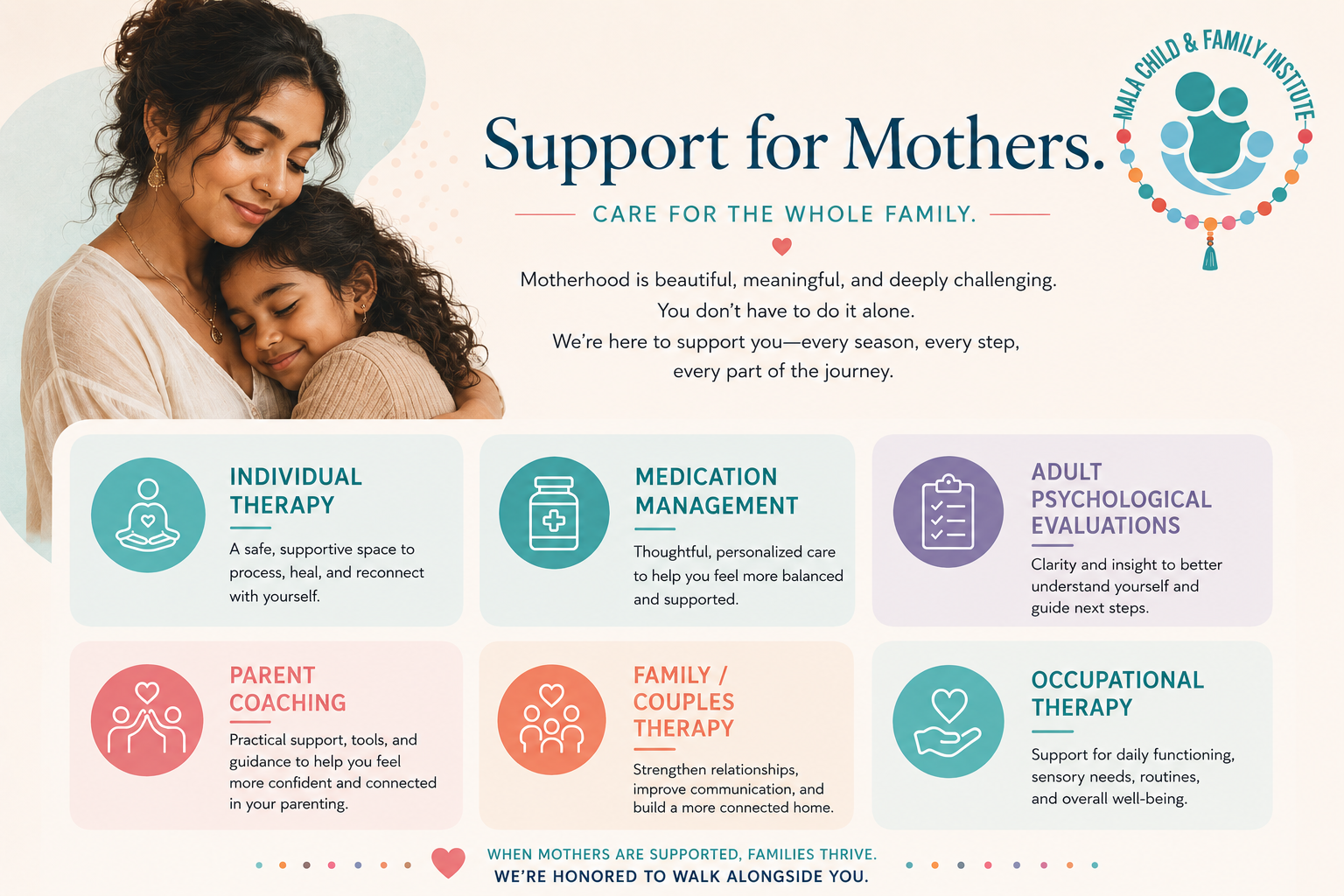
If you have any questions concerning care at Mala or would like to reach out for another reason, we’d love to hear from you.
Until next time,
The Mala Child & Family Institute Team
