
Doing It all Without Losing Yourself: How to Prevent Parental Burnout
By Amanda O’Dell, FNP-C
PMHNP Student
Parenthood is a transformative experience that brings immense joy but also substantial emotional and psychological challenges. While the arrival of a child is often celebrated as a source of fulfillment, it also marks the beginning of a period characterized by identity shifts, increased responsibilities, and sustained emotional labor. (Abidin, et al, 2025). I recently came across an article that hit home for me. It made me reflect on something I’ve been noticing lately: “How can I be fully present as a parent without feeling like I’m neglecting my own needs?”

The Weight of Juggling it All
Parenting is, without question, the most rewarding thing I’ve ever done and the hardest job I will ever have. I live in a constant internal tug-of-war, wondering if I’m doing this right. Am I raising good humans? I worry about doing too much for them as a parent, yet at the same time I fear what will happen if I step back and let them fail. Watching them struggle can feel overwhelming, especially when every instinct in my body wants to protect them. I’ll admit it: even at 17 & 14 years old, I still make sure my kids’ backpacks are fully packed with everything they need each morning: notebooks, laptops, snacks, and gym clothes. I have breakfast ready as they rush out the door making sure their water bottles are filled and tucked inside. Lately, I’ve started to pause and ask myself: Am I doing too much? Should I let them forget something occasionally so they can learn responsibility? Or is this simply what love looks like?
Then there’s the worry, the kind that never really turns off. It’s that constant voice reminding me, multiple times a day, even in the quiet moments of all the things I want to protect them from: a new driver behind the wheel, a first broken heart and the things social media exposes them to that I can’t fully shield them from. I worry about their mental health.
Are they okay on the inside?
Are they carrying something they haven’t said out loud?
Do they feel accepted at school?
Do they feel loved?
And, on some days, do they even like me?
That worry creeps into every role I’m trying to balance. While I’m working to make sure my kids are mentally ok and safe, I’m also questioning whether I’m doing enough at work- building a career, continuing my education, still driven to help and serve others. At the same time, I’m learning how to support a newly diagnosed neurodivergent child, navigating school challenges, therapy appointments, and medication changes.
My mind runs in endless circles: bills, broken lacrosse sticks, volunteer shifts, laundry, dishes, dinner and whatever emotional energy remains goes toward keeping my marriage healthy and connected. Then without warning, another role appears: caring for an aging parent, a role I wasn’t prepared for yet. This story feels painfully familiar in so many households. It’s heavy. It’s overwhelming. And it leaves you quietly asking, often in the middle of doing it all: when does it end?
Parental Burnout
“Burnout is a syndrome that involves emotional exhaustion, depersonalization and a decrease in self-fulfillment, caused by constant involvement in emotionally demanding situations”

What we don’t talk about enough is how chronic parental stress impacts mental health. When you’re constantly in survival mode, managing schedules, emotions, expectations, and crises-there’s little space left for rest, reflection, or self-care. Anxiety becomes normalized. Burnout feels inevitable. Guilt creeps in anytime you consider stepping back. Somehow, taking care of yourself starts to feel optional instead of essential.
I know my mental health is deeply connected to the well-being of my kids and the people around me. When I’m overwhelmed, they feel it. It must be okay to miss a volunteer shift, to choose rest without explaining or justifying it. Setting healthy boundaries that allow one to take such time should not bring guilt or shame but rather be seen as vital actions that can ultimately benefit parents and caregivers as well as their children (U.S. Surgeons General’s Advisory on Mental Health and & Well-Being of Parent, 2024).
Taking care of myself isn’t selfish- it’s necessary! It’s modeling emotional regulation, balance, and self-respect for my children. Maybe admitting that out loud, without apology, is the first step toward healing the invisible weight so many parents carry. If you’re feeling overwhelmed, these Self Care Ideas may offer small moments of relief and reset.
“It is impossible to get parenting right all the time so being compassionate and forgiving with oneself is essential. Nuture connections with other parents and caregivers. Parenting is best done with support.”
Strategies That Help Support Change
Talk about it
Opening about burnout can strengthen social support- even though shame and isolation often make this hard.
Shift your perspective
When parenting feels overwhelming, try reframing challenges as part of growth rather than signs of failure.
Make small adjustments
Delegate tasks, lower unrealistic expectations, reduce overscheduling, and lean on available support.
Build parenting skills
Explore workshops, school resources, or therapists offering evidence-based parenting programs.
Drop the “should’s”
Replace guilt driven thoughts with self-compassion
Take microbreaks
Even five minutes to breathe or reset can restore emotional balance.
Reconnect with meaning
Create small, intentional moments that remind you why parenting matters to you.
Mala’s Upcoming Therapy Groups

Healthy Connections
Mondays, 3:00-4:30 PM
March 2 – March 23, 2026
Mala’s Farmington Hill’s Office
$85/session, or in-network with BCBS & Aetna
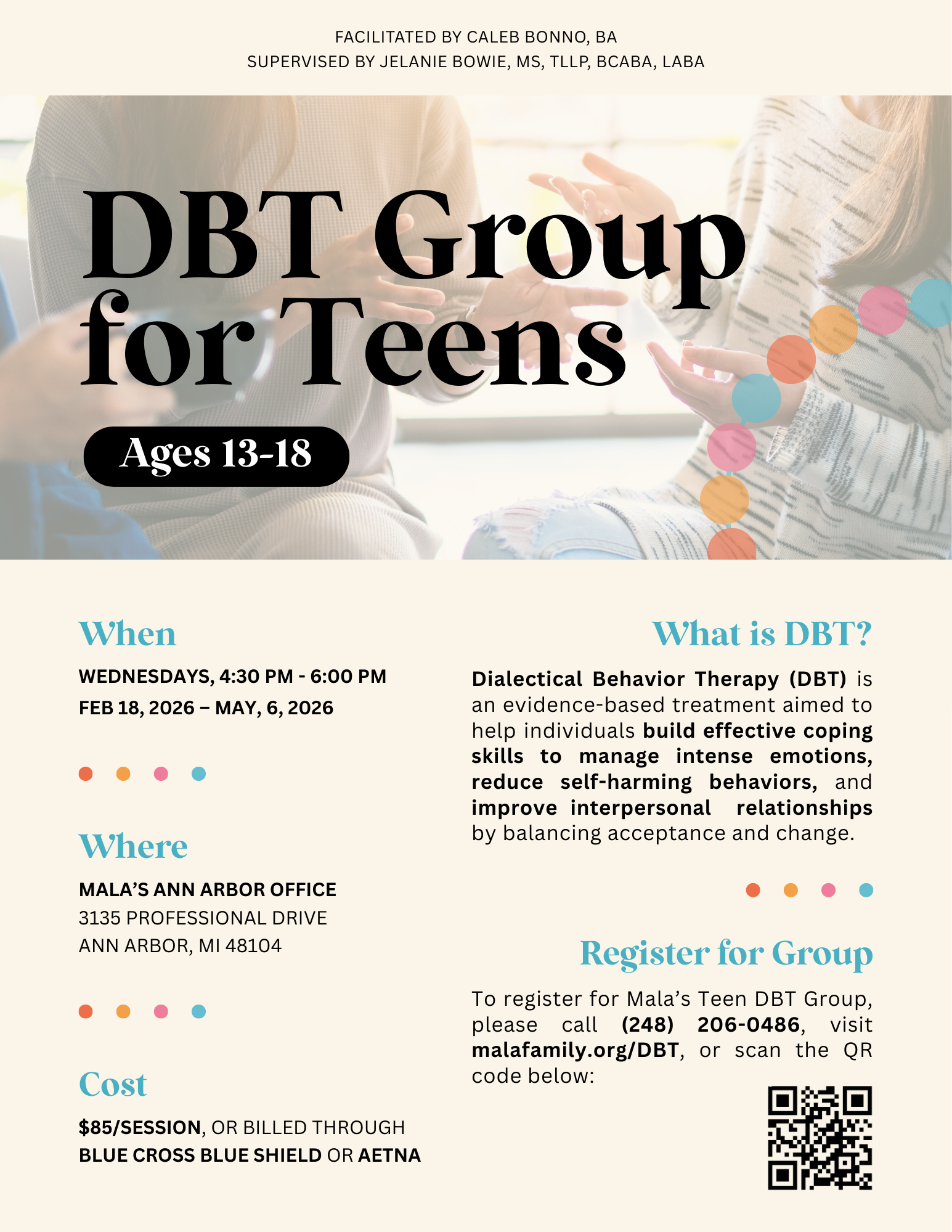
DBT Group for Teens
Wednesdays, 4:30-6:00 PM
February 18, 2026 – May 6, 2026
Mala’s Ann Arbor Office
$85/session, or in-network with BCBS & Aetna
If you have any questions concerning care at Mala or would like to reach out for another reason, we’d love to hear from you.
Until next time,
The Mala Child & Family Institute Team
